








Relate – New Zealand’s Leading Experts in Marriage Counselling & Relationship Therapy
To feel heard, to rebuild your connection, and to make lasting change requires the right couples therapist. Relate is New Zealand's largest team of relationship specialists. Request a call back and speak with our director or manager and we'll find the right therapist for you.

Relationship Crisis Assessment
When your relationship is in trouble, sometimes there is not a lot of time to waste.
Crisis Assessments will get you a session in the next week with our Clinical Director Steven.
If you are facing a catastrophic problem e.g. an affair / someone threatening to leave etc. you can book a 2 hour Rapid or a 3 hour In Depth Assessment with Steven.
Book Crisis AssessmentWhy Choose Relate for Couples Therapy?



Relationship Counselling Issues We Work With

Betrayal Recovery
When trust is broken from an affair or other betrayal, the path forward seems daunting. We help you navigate the tough times with specialized crisis interventions.

Communication & Conflict Resolution
Struggle with misunderstandings? Our strategies enhance dialogue and understanding between partners.

Get Reconnected
Feeling Unheard? If you feel your concerns are minimized, we provide tools to help both partners feel valued and heard.

Stay or Go
Uncertain about decision dilemmas? We offer guidance to help you make informed relationship decisions, including divorce counselling.
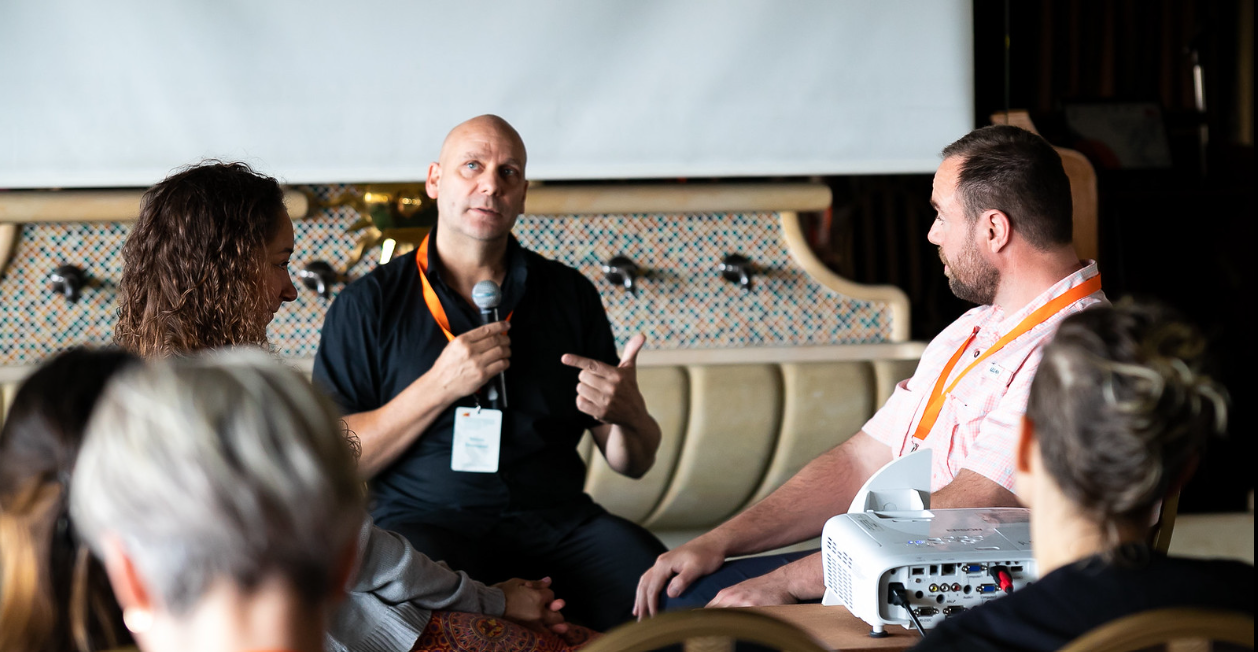
Relate's Director, Steven Dromgool, Teaching Relationship Therapy
Couples chose Relate because their relationships improve more and faster.
Why?
Each team member is a Relationship Expert, they are trained in at least 2 models, have years of experience and have access to supervision from Steven.

Our Vision and Mission
Relate was started with the belief that every couple and their children deserve the best possible help. To get better connected, which is the best and fastest way to create a better world.
Frequently Asked Questions About Couples Therapy
What is relationship counselling really like? A tale from the counselling chair.
What is relationship counselling really like? A tale from the counselling chair.
With 80% of the couples we see, at least one person in the relationship has had absolutely no kind of therapy or counselling before – which can make it a nerve racking experience.
Add to this the fact that kiwi men are taught very clearly that being vulnerable and talking about feelings means you are a lesser man and it’s clear how much our male clients must love their partners to even consider coming to therapy.
So with this in mind, I’d like try to paint a picture of a ‘typical’ first session*. In a sense, I hope to lift the veil a little on the experience.
RELATIONSHIP COUNSELLING – A Moment in the first session with Jane and Matt
Matt and Jane have been married 8 years, they have 2 small children, Emma has just turned 3 and James is about to start school in one month. They met in their final year of University. Jane was studying to be a librarian and Matt was studying accounting. Jane sent me an email when making the booking. This is our last chance – I don’t think I can do this anymore.
They arrive a few minutes early for 8:30 appointment, both clutching hot cups of coffee. Steven comes out and greets them and ushers them in. They spend a couple of minutes in small talk, auckland traffic, the weather. Steven notices that Matt looks pretty nervous, glancing around the room, gazing at the floor, his voice a little higher than normal. Jane is nervous too (mostly about Matt it appears) she keeps glancing at him, quick darting sideways glances.
In these 2 minutes Steven already has a preliminary picture of the relationship. This couple cares about each other and the relationship. Matt is probably an emotional avoider which is why he is most nervous in this setting. Jane is a caretaker, but feeling overwhelmed, her quick gazes indicates she is unsure Matt will respond to caretaking. She is also unknowingly subconsciously triggering his fight/flight pattern – (quick sideways glances are a threat indicator to mammals).
Steven is smiling, breathing slowly and deeply. Seeing the couple’s care pattern, even though it’s not working well at the moment, gives him a strong sense of hope. Commitment and care are the two magic elements he can’t produce – changing patterns on the other hand, that is a far simpler task. Knowing he needs to distract the couple from their pattern Steven thanks them for coming and starts to explain a bit about the process, he jokes a little, watching Jane visibly relax when Matt chuckles. He asks them about their counselling experiences – Matt none, Jane some individual counselling when her dad died.
Steven acknowledges that they would probably feel nervous, coming along and expresses his appreciation for their courage. He also comments that they clearly care a lot about each other to embark on this new experience. Matt and Jane glance at each other directly for the first time. Matt’s whole face softens and he smiles gently at Jane. Her lower lip quivers and her eyes fill with tears. Matt starts to look alarmed.
Steven captures their attention, speaking as if he hadn’t noticed. Matt clearly doesn’t know it but he just made a big step. His loving glance (the first Jane can remember in months), along with Steven’s comment about how difficult it was for Matt to come suddenly gave Jane some hope – her tears are hopeful.
Overwhelmed with the stress of being the primary caregiver and managing a part time job, Jane has been feeling neglected and unloved since Emma (their 18 month old) was born. Her typical response, to wait and then to complain in the hope of receiving emotional care simply triggers Matt’s defense of retreating and working harder. He reads her tears as yet another signal that he has failed. Inside Matt wonders what happened to the gentle, loving, playful woman he met in University. He misses sleeping in, spooned closely together and the way she used to trace his face with her finger. Jane misses the responsive, confident, caring man she fell for. She misses how Matt could sweep her up with his energy and optimism. She misses the feeling of aliveness and sensual connection between them – she misses her friend.
Steven is feeling pretty hopeful, there are multiple markers of a strong connection and mutual care. His next task is to reduce their anxiety so they can see it. Steven guides them both in a centering exercise after briefly explaining the effect on the brain. Matt who would normally be averse to this ‘hippie bullshit’ was intrigued by the science and gives it a go. Steven notices their breathing slow as they both begin to relax, he guides them to think about their longings and their intentions. Still with their eyes closed he instructs them to turn their chairs to face each other. He instructs them that when they hear the bell chime to open their eyes and look at their partner.
The bell chimes. Jane’s eyes are open instantly, looking at Matt. Her eyes already starting to narrow and her pupils constrict. Matt’s eyes open more slowly he blinks a couple of times focusing on Jane’s face, then a small smile curves on his lips, his pupils dilate slightly and he gives a gentle sigh. Jane’s breath catches slightly, her face freezes and her lower lip starts to wobble, her eyes fill with tears. Matt starts to speak, catches himself, and looks incredibly tenderly at Jane. He moves his leg forward to brush against Jane. Jane takes a deeper breath and her face starts to relax, she returns a tentative smile. Matt beams. Jane leans forward slightly and touches Matt’s knee and his hand reaches out to cover her hand. They have forgotten Steven is in the room.
This behaviour – called limbic resonance – entrains the couple’s heart rhythm, synchronises their brain to work more efficiently, lowers stress hormones like cortisol, increases oxytocin and testosterone levels. What we call relational presence is the universal marker of attuned relationships. For Matt and Jane it feels like magic. Steven’s aim in this first session is to create multiple opportunities for them to experience it. Along with explanations of what is happening so they can begin to duplicate it at home.
*because NZ is a very small and close knit society, and confidentiality is paramount we opted not to identify individual clients so this story is a kind of composite couple to help paint a picture.
What are the different counselling approaches and what do they mean?
What are the different counselling approaches and what do they mean?
Comparing Imago relationship therapy, Emotionally Focused Therapy and Gottman Method therapy
In the world of relationship counselling today there are three big players, these are Imago Relationship Therapy developed by Harville Hendrix and his wife, Helen Kelly Le Hunt; Emotionally Focused Therapy, developed by Sue Johnson and Les Greenberg and Gottman method therapy developed by John and Julie Gottman. There are two more recent approaches HEART and PACT (Psychological Approach to Couples Therapy) which I will discuss in another article – these two approaches are more recent and integrate aspects of the first 3 approaches and neuroscience and to my knowledge I (Steven) am the only NZ therapist trained in either of these two so they are less relevant at the moment.
As a specialist marriage and relationship counsellor I have personally trained in all three of these relationship counselling approaches and am often asked by people contemplating training my thoughts on which approach I would recommend; or by practitioners of a particular approach for my endorsement of their particular model. From my perspective I see each of these approaches as having particular strengths and weaknesses and in an ideal world everyone would train in all three of them. What I would like to do in this article is to highlight what particular strengths and weaknesses I see in these approaches, with a view to informing others trying to make their choice. I should say by way of full disclosure that I am significantly more trained in Imago Relationship Therapy.
When I think about what I like most about imago relationship counselling it has to be the dialogue. The story goes that Harville and his second wife Helen were engaged in conflict and Helen told Harville that they should take turns speaking and listening. They must have been a relatively OCD couple because they took this very literally and literally repeated every single word that their partner said word for word. And what they discovered was that something magical happened in their connection when they did this. This approach has been strongly validated by a series of findings in neuroscience which showed that the close gaze and mirroring activates mirror neurons in the brain. These mirror neurons are widely considered to be the basis of the human/mammalian capacity for empathy. Other findings indicate that seasoned practitioners of dialogue experience a brain state that is similar to meditation. All of our team have some training in Imago Relationship Therapy.
For a large number of clients, they may experience this in the first session of couples therapy. The core feature of the typical imago session is a sense of peace and calm stillness and deep listening. For a lot of clients this is incredibly powerful because it is a powerful counterbalance to the fear that they had coming into counselling that it would simply be an emotional boxing match. In my experience imago practitioners tend to be very passionate about the work they have done and it does seem to be work that they use practically in their own life. This has certainly been my own experience. It’s also noticeable that even clients who just are mirroring in the client sessions and don’t practice their homework, still notice a significant improvement in their ability to listen more deeply to each other. The question that remains because of the lack of research is how long this effect lasts for. It should be noted that this is a weakness present in all of the main models of couples counselling book which is a significant relapse rate among couples.
The weaknesses of the Imago. Imago is a lot easier for avoidant clients (often males) because the emotional intensity is lower it tends to help avoiders reduce their flooding and arousal (getting upset). This can be a strength of the model as the maximiser is so grateful to see the minimizer relax and opening up that they will cope with what they find difficult about the model. For maximisers, or insecurely attached ambivalent clients, they often find it difficult to manage this slower pace brought on by the need to mirror every word. A skilled imago practitioner can often handle that extremely adeptly and help the couple see the payoff for persisting, however there is a group of clients in my experience about 15 to 20% who simply do not love or enjoy the imago dialogue in my experience the most common reason for this is having highly intellectual or cognitive clients who don’t understand why they need to repeat word for word and so it’s possible to get into a bit of a power struggle or to have someone checking out because they simply don’t understand why they are mirroring word for word. Another problem with the dialogue process, is that couples often experience a sense of bliss in the connection in the session and then they go home fall into conflict and it often feels worse because they have just experienced a sense of love and connection. Some clients also so enjoy the newfound sense of peace and harmony that they now want to avoid conflict so that they don’t rock the boat and sometimes need to be coaxed and reassured that the dialogue can be used to help them deal more safely with difficult conflict and help them find that place of deep connection again afterwards. As you can see a lot of the weaknesses of imago are actually tied to its strengths but the fact remains that there is a definite subset of clients who don’t enjoy the imago dialogue process.
How do I make relationship counselling work for me?
How do I make relationship counselling work for me?
What you need from a therapist?
You need someone competent and trained in working with couples. Relationship therapy is specialised and being a good individual therapist does not mean that someone is qualified to work with couples. You need someone who will be clear about what they can, and can’t do, and is upfront about the costs, benefits and limitations of therapy.
What a therapist needs from you?
Desire and Commitment are the two key indicators of success in relationship counselling. The work is challenging, difficult and if embraced can be life-changing. Clients often come to relationship therapy secretly hoping the counsellor can wave a magic wand and make everything work instantly – that would be nice. A better analogy is getting a builder to come and look at the house you and your partner have constructed together and start giving you some guidelines and instructions on how to set things in order. It’s still hard work but there is the reassurance of knowing you are working with someone who has seen the process of restoring love in a marriage occur many times before. It is wise to recognise that it will cost in terms of time, money and (the most challenging piece) risking hurt by being vulnerable.
The good news . . .
Building a good relationship is not only possible it’s what we are created for. In fact many of our most painful experiences in love, are invitations to growth.
Welcome to the Journey
BTW, some couples wonder weather or not online marriage counselling will work for them. We found that about 50% of couples prefer online couples therapy.
Will relationship counselling help us prepare for and survive parenthood?
Will relationship counselling help us prepare for and survive parenthood?
Absolutely, unequivocally yes!
There are perhaps few things in life that are simultaneously as wonderful and terrifying as the impending arrival of a child.
Children come in many ways, an unexpected surprise, the result of years of waiting, IVF, adoption.
And every child is different and the bonds we form (or fail to form) will impact us all in different ways.
Unfortunately a common casualty of the parenting relationship is the couples relationship bond. Sleep deprivation, differing parenting styles, financial challenges and lifestyle changes can all conspire to erode the love and intimacy connection between couples. These factors conspire to lead to a divorce spike around the time children are 3-5 years of age.
However despite the uncertainty there are now literally decades of good quality research about how to connect well with baby but more importantly to maintain and strengthen the parenting and couple connection. In this area it is truly possible to have your cake and eat it.
This is an area close to the heart of most of our team – we love babies.
To book a session with one of our counsellors for relationship counselling and antenatal coaching click here.
Check out the video below for a fascinating and useful video about babies language.
Getting men to talk - the secret weapon
Getting men to talk - the secret weapon
What most woman are looking for in a listening conversation is Empathy, a right brain limbic response. Despite the protests about men trying to fix their problems the fact is that women offer solutions all the time to other women and to their men and are happy to receive solutions IF they feel the sense of limbic resonance that occurs when someone activates their mirror neuron network (see part 2 for more about the mirror neuron network) and feels with them. This is clearly shown in the video when the guys says, “that sounds .. tough,”.
What men are typically looking for is Validation. Validation is largely a left brain cortical response that says, “You make sense to me, you are not a crazy person, I understand why you think the way you do. Note it does not necessarily mean you agree. When a man gets Validation he is then open for Empathy, which enables him to feel more connected and a man will feel very loved when he receives care in this order.
So the first rule is Validation first, then Empathy. When a guy has a problem he wants to fix it and so he will be collating information in the back of his head at the TPJ (temporal parietal junction) and feeding it forward to his left prefrontal cortex to problem solve. He will actively be avoiding his emotional connection with his right limbic brain so that he does not get overwhelmed and feel helpless. A woman who listens to his work issues and says, “wow that’s so tough, or so unfair, you must feel really humiliated,” i.e. showing wonderful Empathy is actively drawing him into his right limbic brain – which for most guys is unfamiliar and highly uncomfortable. Many (not all) men will feel uncomfortable at this point and want to clam up.
There is a very real brain reason for this difference. Most women have up to 80% more connections in the corpus collossum the thick band of neural connections that bridge the left and right hemisphere of the brain. This means that jumping back and forth between right and left hemispheres is quick and easy. This is what enables women to link emotional and logical processes very easily whereas men tend to do them one at a time. First logic then emotion. Reversing this order is additionally difficult for men because they are taught from very young to actively avoid emotion.
However when a woman Validates a man’s actions or thought processes, “Yeah it makes sense that you felt mad, I can see why you hate that guy, I understand that you wanna move to Alaska and live in an igloo,” it acts as a clearing house for his thoughts. NB you are not agreeing to go to Alaska to live in an igloo with him you are just saying that you understand his work environment today was so tough that Alaska sounded awesome.” Validation in this context is essentially thought empathy and men find it incredibly soothing – and it enables them to move on to more productive thoughts and problem solving.
The biggest benefit for the woman is that the guy just learnt that he can share his slightly crazy thoughts and he will be understood, accepted and loved – and men will take a bullet for a woman like that. I have on countless occasions coached a woman to listen, summarise what her partner says and say, “I listened carefully to you and what you said makes sense to me,” and seen the man’s eyes well up with tears and he breathes out this huge sigh of relief – because suddenly he is not alone in his world. At this point empathy can be added and it provides an additional layer of connection.
So try it this week, just casually in a conversation with a man, just nod as he talks and then just say, “yeah I get that it makes sense to me.” You may find this introduces a new problem for you where they want to talk to you all the time (or they may just grunt and nod – but they are 100 times more likely to talk to you again) …
Part 2 – More about the Mirror Neuron Network
Imago Therapist Pat Love in a recent talk commented on the fact that the brain actually has two empathy networks. The first is the one most woman are familiar with called the mirror neuron network.
This network enables us to literally feel into the world of another. Mirror neurons were discovered by accident during some trials on monkeys brains. During a break one of the researchers grabbed some of the monkeys’ peanuts and began shelling and eating them. The watching monkeys’ brain lit up as if they were actually eating the peanuts themselves.
Fun point: A similar version of this experiment can be tried by getting some men to watch any of the many Jackass episodes where one of the guys gets kicked in the testicles – observe how the watching men silent curl up around themselves and moan in a classic empathy display.
The second network is what Pat Love calls the TPJ (Temporal Parietal Junction) network. This part of the brain assimilates incoming data in order to assess a best course of action. It’s what enables firemen, ER nurses, doctors and paramedics to come to a disaster scene and triage how to most effectively help.
Men obviously are socialised more towards the TPJ network in fact Pat Love’s book How to improve your marriage without talking about it trades on this fact.
So when men are doing offering help and suggestions what they are actually offering is empathy – when their help is rejected or judged it creates a very unsafe atmosphere and many men tend to withdraw and withhold love and support to avoid being attacked.
There is a handy technique that can avoid these kinds of conflicts in your relationship. If you are upset and want mirror neuron empathy tell your partner something like this, “I’d like to share something and what would really help me is if you listen to me hold my hands and try and imagine what it feels like being in my world. This would make me feel loved and understood by you and I will probably feel more connected to you (and you might get lucky – is an optional but very effective ending :-).”
If you partner is wanting empathy but you don’t know which type simply ask, try, “I’d like to listen to listen to you well and it would help me know if you are wanting me to simply listen and try and understand your world or if you want me to think up some brilliant solutions?” Then give them what they asked for.
Finally the important thing to remember is what you appreciate is what you get more of. If you partner gets this even partly right, tell them how much you appreciate what they did right and the impact it had on you – this gives your partner the tools to be more successful in loving you.
It’s not about the Nail (the video above) is still one of my favourite short videos but I’d like to flip this topic on its head and talk about listening to men. In my work as a marriage therapists who specialises in helping couples communicate it is pretty common for couples to enter the counselling room with an assumption that the woman in the relationship is the superior communicator. Because normally (not always) she talks more, she will say its important to communicate and she will initiate conversations and invite her partner to talk to her. Now these can be very positive steps in the relationships however without a particular order of listening a woman will have very limited success in getting a man to continue to talk. And this order is directly opposite to what most women want.
Check out our Online Relationship Course for more videos and help with your relationship.
How much does help cost?
How much does help cost?
At Relate our team ranges from new interns to therapists with decades of experience – so prices range between $60 and $225 per hour.
How long does it take to get an appointment?
How long does it take to get an appointment?
Appointments for individual or relationship counselling are available almost every day with us. When you get in depends on your personal availability. Late and early appointments tend to be more sought after. If you are flexible, most counsellors can see you within a couple of days. If you want the last appointment of the day it may take a fortnight to a month. If you need an urgent appointment and you can’t see something online email, phone or text us
What if my partner doesn’t want to go to couples counselling?
What if my partner doesn’t want to go to couples counselling?
It is normal in a relationship that one person is more reluctant to attend counselling than the other. It is important to realise that you cannot force your partner to attend. Some things that may help are a direct request to attend for your sake, e.g. “I know you are not keen to attend counselling, or don’t think we need counselling I would really appreciate it if you would attend one session with me for my sake.” If there is a particular problem and they are resistant to counselling, ask them, “How do you think we could resolve this?” Agree to try their plan and ask them to support your plan of counselling as well. Get a couple of therapist profiles and ask them which person they would prefer to see. Guys in particular are much more likely to commit to one trial session to test out the therapist and frankly, I think its a pretty good approach. What is unlikely to work is getting mad and threatening them, saying, “You need to get help”, etc.
The course 'What Divorcers Wish They Knew' includes an interview specifically about how to encourage your partner to participate in couples counselling. Get a 3 Day Free trial of 'What Divorcers Wish They Knew Here.
For relationship concerns we will always advise couples counselling. However, individual counselling can help your get ready for changes.
Do you work with families and youth?
Do you work with families and youth?
Some of our team do –Joy and Garey have a particular interest in families and youth, Stefanie does family sessions. Feel free to email or call us prior booking to check.
Relate’s mission
Relate’s mission
Is to provide you with expert relationship counselling or couples therapy help. We specialise in working with marriage and relationship issues for couples and singles. Our team are experts in relationship counselling and are committed to help you improve or even rescue your relationship. Our therapists can see you ONLINE or in person. Appointments are offered weekdays, after hours and weekends. Relationship Therapy Assessments and Intensives are also available.
The Relate team also regularly creates training and informational articles and videos to address common marriage and relationship issues and train other therapists in the approach we developed PORT (Presence Oriented Relationship Therapy).
Individual relationship counselling
Individual relationship counselling.
Individual relationship counselling can be used for a variety of reasons including a partner who is unable or unwilling to attend counselling; someone who has been single for a long time or in a series of destructive, unhappy relationships, or it might be used alongside couples therapy, or to deal with past trauma issues. It can be useful to get a therapist of the opposite gender to talk through relating to the opposite sex.
Relationship Counselling in New Zealand
Find a local relationship therapist or...
If you are looking for couples counselling in Hamilton, marriage counselling in Christchurch, relationship counselling in Wellington, or relationship counselling in Christchurch you can schedule online relationship therapy.